Upright, Console, Studio, Spinet: What the Words Actually Mean
The words on a piano's spec sheet aren't marketing, they describe real differences in height, action, and tone. Here's what each one means.
September 2, 2026 · 4 min read
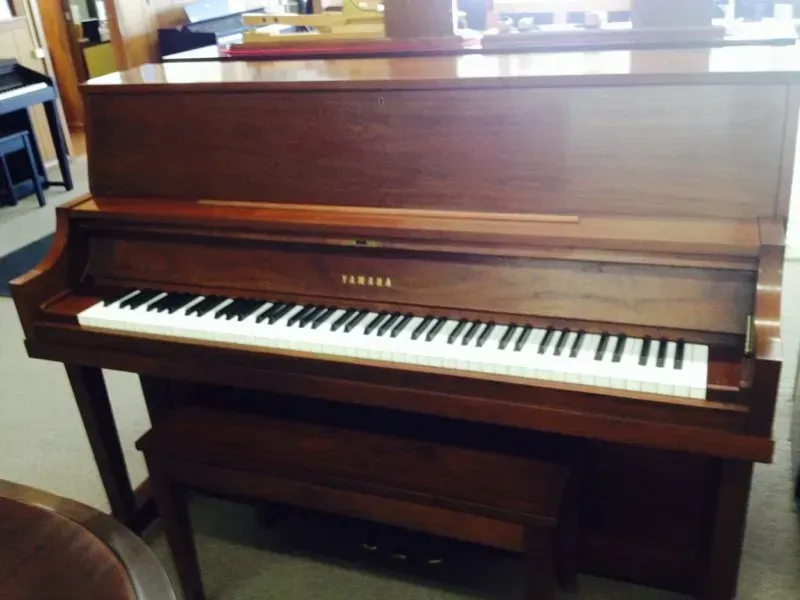
People come onto our showroom floor at 1504 Lamy Ln and hear terms like console, studio, and spinet used like they're interchangeable, and they aren't. Each one describes a real difference in cabinet height, and cabinet height on an upright piano does more than decide how it looks in a room. It sets how long the strings and soundboard can be, and that shapes tone and sustain. Here's what the words actually mean, stripped of sales language.
Spinet: the shortest cabinet
A spinet is the smallest upright, generally under 40 inches tall, with an action mounted below the keys rather than directly behind them, connected by a drop-down linkage. That linkage makes spinets harder to service and regulate well, which is part of why fewer spinets get built today than in past decades. If you come across one, it's likely an older instrument. They fit in tight spaces, but the compact action and shorter strings mean less tone and sustain than a taller upright.
Console: the common middle ground
A console piano sits around 40 to 43 inches tall, with the action mounted directly above the keys, the more standard, more serviceable arrangement. This is the size most people picture when they think of a home upright, and it's a genuinely good fit for most households, tall enough for real tone, compact enough to fit against most walls. Our Wurlitzer French Provincial console, cherry finish with carved fretwork, and the Hammond A100 console organ in cherry are both good examples of what a well-built console cabinet can offer, in tone and in cabinetry.
Studio: built for the practice room
A studio upright runs roughly 44 to 47 inches, taller than a console, which means longer strings, a bigger soundboard, and noticeably fuller tone and better sustain. These are the uprights you'll find in serious practice rooms and small studios because they give a player more to work with without stepping up to a grand. Our new Yamaha P-22 studio, walnut finish, sits in exactly this category, a genuine step up in tone from a console while staying an upright's footprint.
Baby grand: horizontal strings change everything
Once you move to a grand piano, the whole mechanism changes orientation, strings run horizontally instead of vertically, and gravity works with the action instead of against it, which is part of why grand actions generally feel more responsive under the fingers. A baby grand is the smallest common grand size, typically 5 to 5 and a half feet. Our new Yamaha 5' GB-1K in polished ebony and a pre-owned Young Chang 5'2" baby grand in polished mahogany that's come through our floor both sit in that size range, real grand tone and touch without needing a formal music room to fit one in.
- Spinet: shortest, under 40in, action below keys, harder to service well
- Console: 40 to 43in, action above keys, the common home upright
- Studio: 44 to 47in, fuller tone and sustain, built for serious practice
- Baby grand: horizontal strings, roughly 5 to 5.5ft, a genuine step up in touch and tone
Why this matters when you're actually shopping
None of this is about one size being better than another in the abstract, it's about matching the instrument to the room and the player. A console in a small den will serve a beginner well. A studio upright makes sense if you've got a dedicated practice space and want more tone to grow into. A baby grand is a different kind of commitment, in space and in what it asks of the room around it. What we'd rather do than describe all this over the phone is have you come play a few, side by side, and hear the difference in sustain and tone for yourself.
Cabinet finish is worth a mention too, since it's the part most people notice first and price last. Walnut, cherry, and polished ebony all show up across our floor on different instruments, and the finish doesn't change the tone, but it does change how the piano sits in a room and how it ages over decades of daily use. Don't let a finish you love talk you into a size that doesn't fit the room, and don't let a size decision blind you to a finish you'll be looking at every single day.
Our floor turns over regularly, so what's here today, consoles, studios, baby grands, is worth checking before you drive out. Call James at 318-372-1449 or Frank at 318-680-5737, or stop in Monday through Saturday, 10 to 5, at 1504 Lamy Ln. We've been sorting Monroe families into the right size piano since 1946, and it's still easier to explain with your hands on the keys than over the phone.
Paul Hewitt Music Co. — (318) 372-1449
Call (318) 372-1449More articles
Buying Your Child's First Piano: What Actually Matters
Before you worry about baby grand versus upright, get the three things right that actually decide whether your child keeps playing.
The Hammond Organ and Its Tone Cabinet: Why the Pair Matters
A Hammond without its tone cabinet is only half the instrument. Here's what that second box is doing and why it matters.