Buying Your Child's First Piano: What Actually Matters
Before you worry about baby grand versus upright, get the three things right that actually decide whether your child keeps playing.
September 2, 2026 · 4 min read
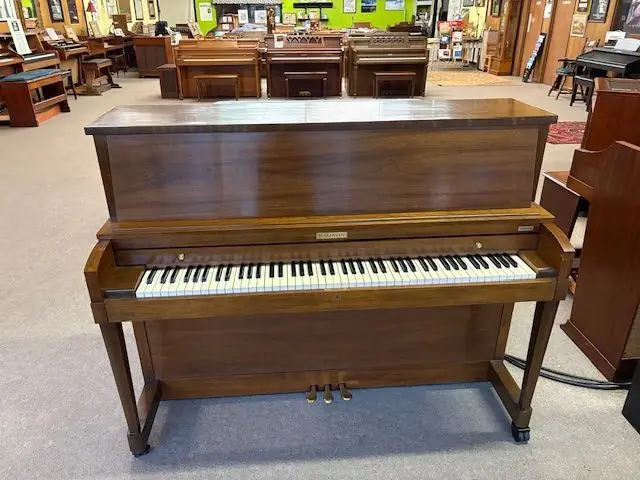
Every family that walks onto our floor at 1504 Lamy Ln with a kid in tow asks some version of the same question: what's the right first piano? It's a fair question and a harder one than it sounds, because the honest answer has almost nothing to do with size, brand, or how the piano looks in the living room. It has to do with three things: the action under the child's fingers, whether the instrument will hold a tuning, and where you actually plan to put it.
Start with the action, not the price tag
Action is the mechanism that connects a key to a hammer to a string, and it's what teaches a beginner's fingers what a real instrument feels like. A weighted, graded action, heavier in the bass, lighter in the treble, is what every acoustic piano and every decent digital gives you. A cheap keyboard with springs instead of weighted keys will let a child play, but it won't teach the hand anything true. If your child is going to take lessons seriously, even for a year, the action is the one thing not worth compromising on. Sit down and play a scale before you decide anything else.
This is also where used instruments earn their keep. A pre-owned upright with a solid action built decades ago can teach a beginner's hand better than a brand-new budget keyboard, because the mechanism was made to a standard that held up. We've had Yamaha, Young Chang, Wurlitzer, and Everett pianos come through our doors over the years, and what separates a good first piano from a frustrating one usually isn't the badge, it's whether the action was built well in the first place and cared for since.
Tuning stability is the quiet dealbreaker
A piano that won't hold a tuning is a piano that discourages practice, because everything sounds slightly wrong all the time and a young ear can't tell why. Stability comes down to the instrument's build and its history: has it been kept in a stable environment, has the pinblock held, has it had reasonable care. This is exactly why we'd rather talk you through a specific instrument on our floor than sell you something sight unseen. Bring your child in, play it, and ask us honestly what we know about that piece's condition. What's on our floor changes as instruments come and go, so the best way to see what's currently available is to call 318-372-1449 or stop by.
Where it lives matters more than people expect
An acoustic piano is a wooden instrument, and Monroe's humidity swings hard between seasons. A soundboard that sits against an exterior wall, next to a heating vent, or in direct sun will move more than one placed on an interior wall in a room with steady temperature. That movement is what pushes a piano out of tune faster than normal wear would. It doesn't mean you need a special room, it means think about placement before delivery day, not after the first out-of-tune practice session.
- Play a full scale on the actual instrument before buying, don't judge by looks alone
- Ask specifically about the piano's tuning history and where it's been kept
- Pick an interior wall, away from vents and direct sun, for the piano's new home
- If space or moving is tight, ask us, delivery and moving are worth a conversation before you buy
- If your child is genuinely new to the instrument, a well-maintained used piano can outperform a cheap new one
A note on digital pianos for beginners
Digital pianos have their place, especially in a smaller home or an apartment where volume and space are real constraints, and where weighted, graded action is standard now on anything worth buying. What a digital can't replicate is the physical response of real strings and a real soundboard, the tiny variations a young player learns to feel for. Neither choice is wrong. It depends on your space, your household, and how seriously your child is starting out. We carry both new and used instruments and can walk you through the tradeoff honestly rather than pushing whichever happens to be on the floor that week.
What to actually do next
Come in. Bring your child. Let them sit down and play something, even just scales, on two or three different instruments so they can feel the difference themselves. We've been helping Monroe families with exactly this decision since 1946, and the honest advice hasn't changed in that time: buy the instrument the child will actually want to sit down at, one with an action that teaches the hand correctly and a build that will hold a tuning. We're open Monday through Saturday, 10 to 5, closed Sunday, at 1504 Lamy Ln. Call James at 318-372-1449 or Frank at 318-680-5737 if you want to talk through what's on the floor before you drive over.
Paul Hewitt Music Co. — (318) 372-1449
Call (318) 372-1449More articles
Upright, Console, Studio, Spinet: What the Words Actually Mean
The words on a piano's spec sheet aren't marketing, they describe real differences in height, action, and tone. Here's what each one means.
The Hammond Organ and Its Tone Cabinet: Why the Pair Matters
A Hammond without its tone cabinet is only half the instrument. Here's what that second box is doing and why it matters.