You Inherited a Piano. Here's What to Check Before You Play It
A piano that's sat quiet for years isn't necessarily damaged, but there's a real order to checking it before you assume it's fine, or assume it's ruined.
September 2, 2026 · 3 min read
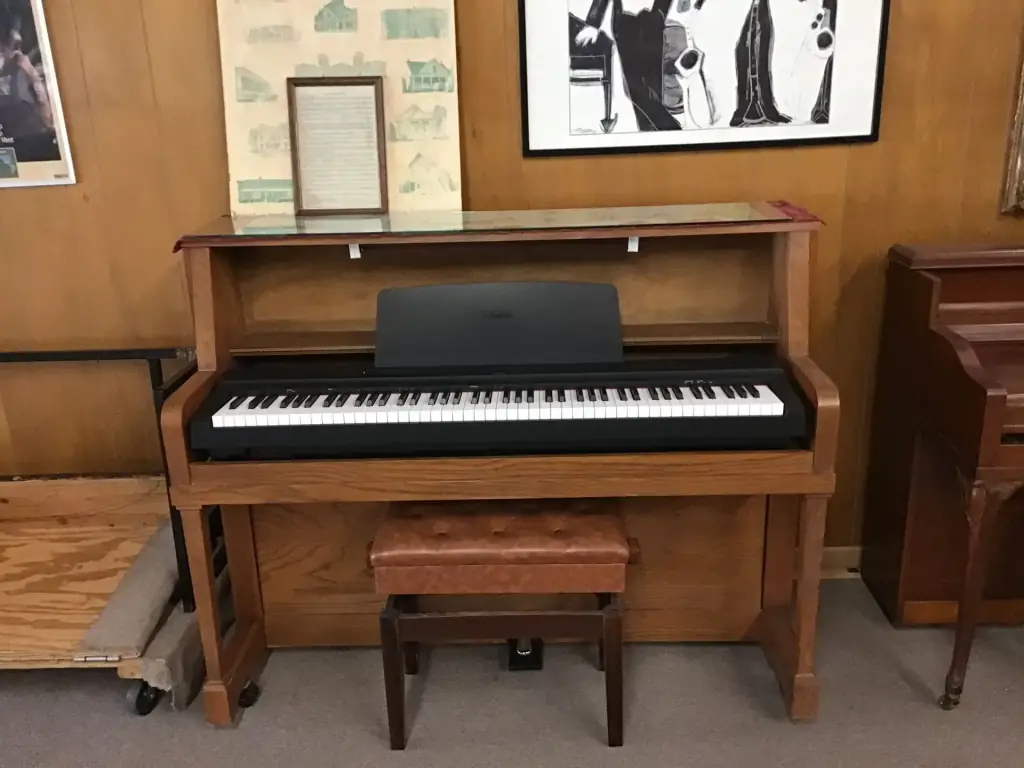
We see this a lot: a piano that belonged to a parent or grandparent, sitting quiet in a house for years, now landing in someone's living room who isn't sure what they've actually got. The good news is that a piano that's been indoors and out of direct weather usually isn't as far gone as people fear. The bad news is that a piano that hasn't been tuned or played in years isn't something you should just sit down and lean into either, there's a real order to checking it first.
Start by just looking at it
Before you touch a key, look the cabinet over. Check for water staining, warping, or separation in the wood, especially along the bottom and back, which tells you something about how it's been stored. Open the top and look inside at the strings and the cast iron plate, surface rust on the strings themselves is common and not usually a dealbreaker, but heavy rust or a plate that looks cracked is a different, more serious problem. Check whether keys are missing their ivory or plastic covering, and whether any keys are visibly stuck or won't return.
Play it gently and listen for what's actually wrong
Once you've looked it over, play through the full range slowly, note by note. A piano that's been sitting will almost certainly be out of tune, that's normal and not a sign of damage, tuning drift happens to every acoustic piano left unattended. What you're actually listening for is different: keys that don't sound at all, notes that buzz or rattle, a general dullness that suggests humidity damage to the soundboard, or a sustain pedal that does nothing. Those point to mechanical issues rather than simple tuning, and they're worth having a real technician look at rather than guessing.
- Check the cabinet for water staining, warping, or wood separation before you touch a key
- Surface rust on strings is common and often not serious, heavy rust or a cracked plate is different
- Play the full range slowly, listening for keys that don't sound, buzz, or a dead sustain pedal
- Being badly out of tune after years of sitting is normal, it doesn't mean the piano is damaged
- A humid attic or garage is a much harder environment on a piano than a climate-controlled room
Where it's been stored matters enormously
A piano that spent years in a climate-controlled living room is in an entirely different position than one that sat in an attic, garage, or storage unit through Louisiana summers. Extreme heat and swinging humidity are hard on a soundboard and pinblock in ways that are often invisible until someone actually tries to tune it and finds the pins won't hold. If your inherited piano came out of a non-climate-controlled space, go in expecting it needs a real evaluation before you invest much hope, or much of a tuner's time, in it.
It also helps to think about who else touched the piano before it got to you. A family piano that was tuned regularly by a previous owner and simply hasn't been played since they passed is a very different situation from one that was already neglected for years before it changed hands. If you know anything about its last tuning or its last real use, even a rough guess, that detail is genuinely useful information when you're deciding what to do next, so don't discount it as unimportant family trivia.
What we can actually tell you
We've been working on pianos in Monroe since 1946, and we keep a service bench for exactly this kind of situation, instruments that need real evaluation before anyone decides whether to restore them, keep them as-is, or move on to something else. We've also repurposed retired pianos into furniture ourselves, a grand piano case rebuilt into a curved bookshelf, an Everett studio rebuilt around a modern Yamaha P-125a keyboard action, so if an inherited piano truly isn't salvageable as a playing instrument, that's not automatically the end of it either. Bring photos in, or bring the piano's story, and we'll give you an honest read before you spend money chasing a fix that may not make sense. Call James at 318-372-1449 or Frank at 318-680-5737, or come by 1504 Lamy Ln, Monday through Saturday, 10 to 5.
Paul Hewitt Music Co. — (318) 372-1449
Call (318) 372-1449More articles
Buying Your Child's First Piano: What Actually Matters
Before you worry about baby grand versus upright, get the three things right that actually decide whether your child keeps playing.
Upright, Console, Studio, Spinet: What the Words Actually Mean
The words on a piano's spec sheet aren't marketing, they describe real differences in height, action, and tone. Here's what each one means.